
Plasterboard - The Servants of Knossos
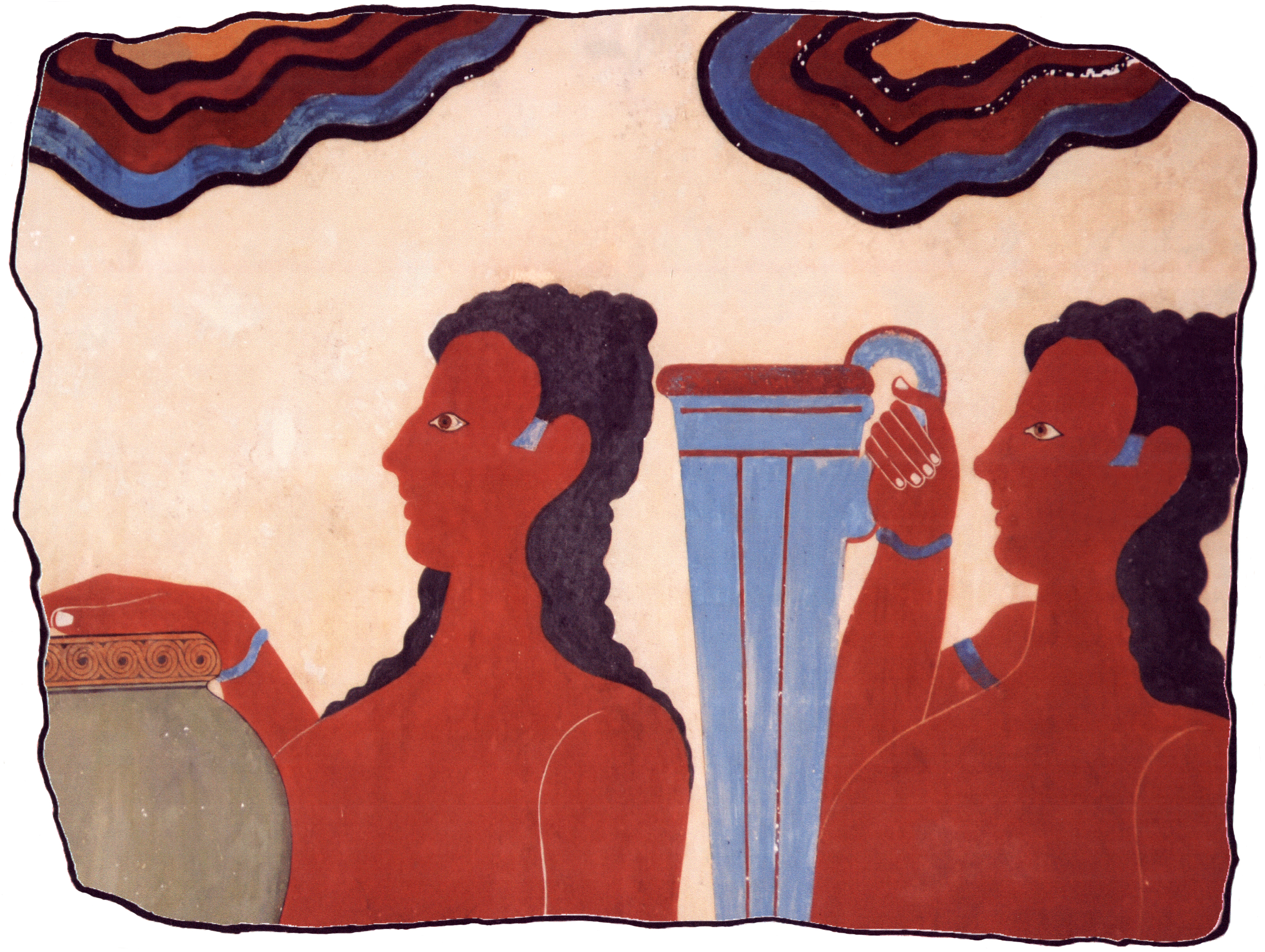
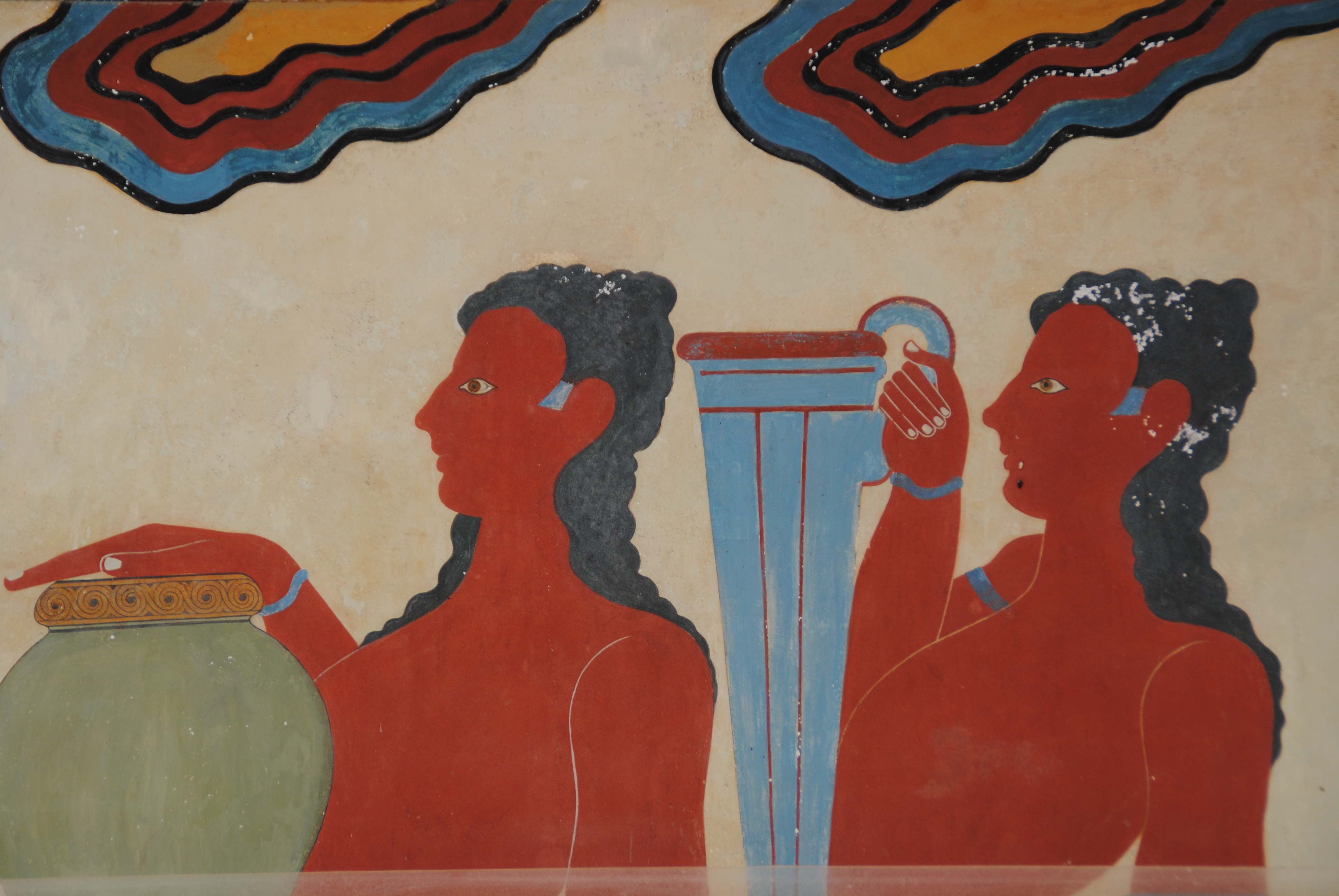
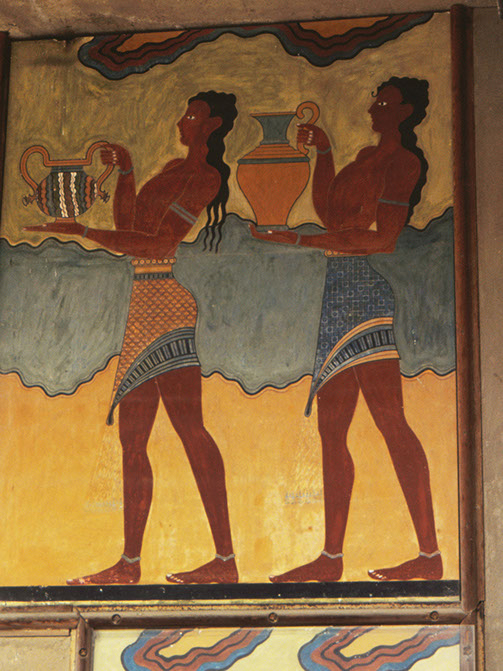
Plasterboard with motif "The servants"
approx. 17 x 22 x 1.5 cmBased on a wall relief, largely completed.
Contents: A plaster plate, a pattern with borders, a painting or colouring instruction, a sheet of carbon paper. a short instruction.
Distributor:
PGI-Skarabäus, Im Kränzliacker 9, 79576 Weil am Rhein, Germany, pgi-shop.de
PGI-Skarabäus, Lerchenstrasse 38, 4147 Aesch, Switzerland, pgi-shop.ch
| Aspiration scale: | Easy |
|---|---|
| Time Line: | 1,5 Hours |
The Minoans
They were the first advanced civilisation in Europe, their seafarers dominated the Mediterranean for centuries and their bull cult was the model for the legend of the Minotaur: the Bronze Age empire of the Minoans, named after the legendary king Minos, is still legendary today.
The Minoans built large palace complexes on Crete around 5,000 years ago, constructed roads and developed a script that is still undeciphered today. Their sphere of influence stretched from the Aegean islands to Cyprus and the coast of Asia Minor to Mesopotamia and Egypt. But as magnificent and archaeologically productive as Minoan palaces such as Knossos or Phaistos are, their builders still pose numerous riddles to researchers. The reason for the decline of the legendary Minoan empire is also not clearly understood.
The wall painting
As early as around 2500 BC, important rooms were stuccoed and then painted red throughout. Since the Middle Minoan period (around 2000 BC), there is evidence of simple geometric patterns in Malia and Phaistos.
Figurative wall paintings were found mainly in the palace at Knossos, but also at other sites. The oldest examples are dated around 1700 to 1600 BC. From the very beginning, the wall paintings show a special preference for nature scenes, flowers and stylised landscapes. Particularly remarkable are the depictions of sequences of movements, which clearly distinguish Minoan art from contemporaneous Egyptian or Mesopotamian art. Here, the so-called flying gallop (see the image of the bull jumpers) should be mentioned, which was then also adopted by the Egyptians. The paintings are also striking for their colourfulness. There are more or less life-size representations, but also paintings that are called miniature frescoes, especially here one finds broad sequences of scenes.
A special feature are flat reliefs in stucco, which were found above all in Knossos. There are figurative depictions here, but also endlessly repeating patterns. These stucco reliefs were usually painted.
Adult supervision:
Children under 14 years of age should use the kit under adult supervision to avoid risks from improper handling.
Risk of injury:
Be particularly careful when handling pointed and sharp parts! Use sharp tools carefully, and if necessary take appropriate safety measures to avoid injuries.
Be careful with small parts:
Hazard of suffocation! Keep small parts out of the reach of small children.
Fire hazard:
Keep away from open fire and heat sources. Product contains highly flammable materials.
Intended use:
The kit may only be used in accordance with the enclosed instructions. Independent modifications can affect the functionality and safety of the built model.